
- Medical License No.: 144189
- 021-8805 0794
- 09128338140
Dr. Zahra Sadat Shamekhi
General Dentist

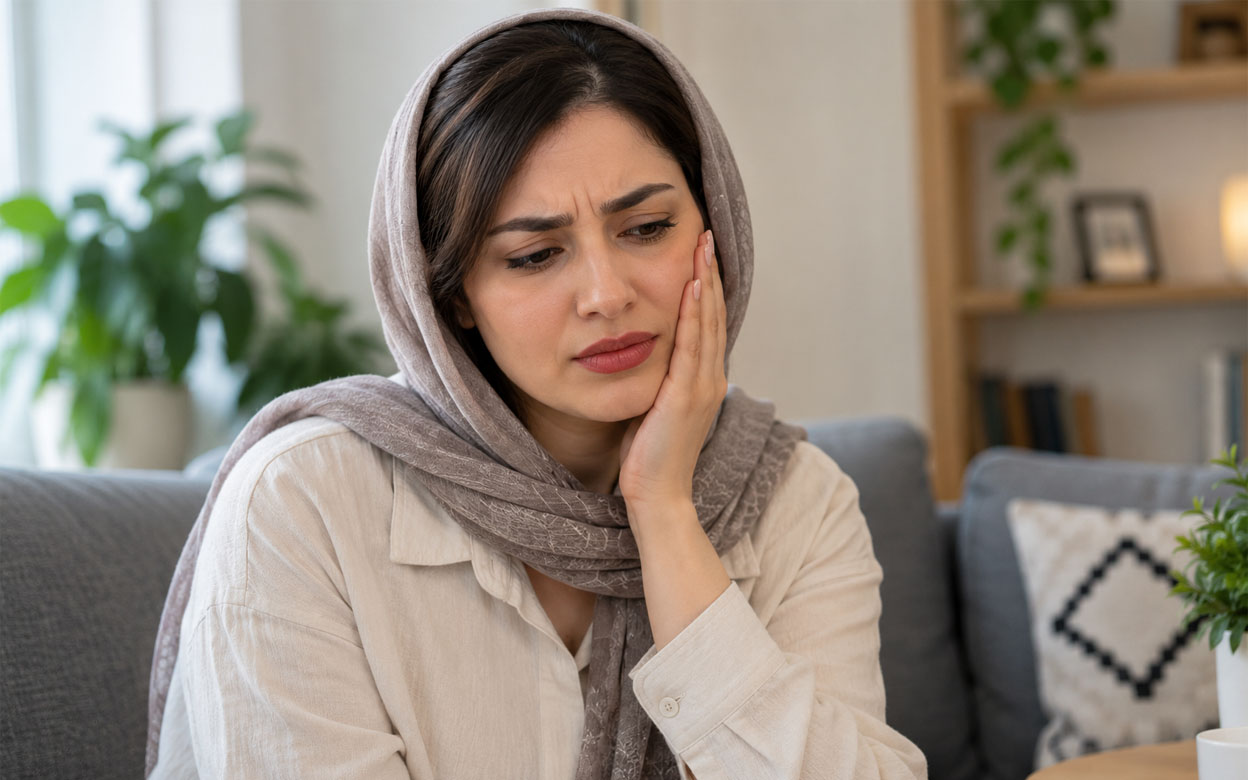
Yes. Mild pain or sensitivity after a dental filling can be normal, especially if the cavity was deep.
Sensitivity to hot or cold temperatures and pressure usually improves within a few days, although it may last several weeks in some patients.
However, severe, spontaneous, or worsening pain requires a dental evaluation.
During cavity removal and dental restoration, the inner tissue of the tooth, known as the pulp, may become irritated.
This irritation can cause tooth sensitivity to hot and cold temperatures after a filling. If the inflammation is mild and reversible, symptoms often improve over time.
However, severe or persistent pain may indicate more serious pulp inflammation.
One of the most common causes of tooth pain when biting after a filling is a filling that is slightly too high.
When the filling sits above the ideal biting surface, the restored tooth may receive excessive pressure when the teeth come together.
This can cause pain while biting or chewing. In many cases, the problem can be corrected by having the dentist adjust the filling.
When a cavity extends close to the tooth's nerve, sensitivity and discomfort after treatment may be more likely.
In some cases, even after the decay has been removed and the tooth has been filled, inflammation inside the tooth may continue and require additional treatment.
Sometimes, pain after a filling may be associated with a crack in the tooth structure.
Sharp pain when biting down or releasing biting pressure can be a sign of a cracked tooth.
A dental examination is necessary to identify the cause.
In certain cases, issues such as gaps around the filling, problems with the bonding of restorative materials, or remaining decay may contribute to ongoing sensitivity or pain.
The exact cause can only be determined through a professional dental examination.
The duration of pain after a dental filling depends on the depth of the cavity, the type of restoration, and the condition of the tooth.
First few days: Mild sensitivity to cold temperatures or pressure may occur.
First week: Pain and sensitivity gradually improve in many patients.
Following weeks: Mild sensitivity may occasionally continue, but symptoms should generally show improvement.
If the pain is severe, becomes worse, or does not improve, you should not simply wait for it to disappear.
To reduce discomfort after a dental restoration, consider the following recommendations:
Avoid chewing until the local anesthesia has completely worn off.
Avoid biting hard foods directly on the sensitive tooth during the first few days.
Temporarily avoid very hot or cold foods and beverages if they trigger pain.
Maintain good oral hygiene using a soft toothbrush and dental floss.
Consult your dentist about suitable pain relief medication if necessary.
Important: If your filled tooth feels higher than the surrounding teeth when you bite down, contact your dentist to have the filling checked.
You should contact your dentist promptly if you experience:
Severe or throbbing tooth pain
Spontaneous pain, especially at night
Pain that lingers after consuming hot or cold foods and drinks
Severe pain when chewing
Swelling of the gums or face
Fever or pus around the affected tooth
Severe swelling accompanied by difficulty swallowing or breathing requires immediate medical attention.
Yes. In some cases, a tooth that has already received a filling may still require root canal treatment due to irreversible pulp inflammation or damage.
However, not every toothache after a filling means a root canal is necessary.
The diagnosis should be based on a dental examination, symptom assessment, and dental imaging when needed.
A high filling, irritation of the tissues surrounding the tooth root, or a cracked tooth may cause pain when chewing. A dental examination is necessary to determine the exact cause.
Temporary irritation of the dental pulp after a filling can cause sensitivity to cold temperatures. If the pain is severe or lasts for a long time after the cold stimulus is removed, further evaluation is recommended.
Mild sensitivity may gradually disappear as the tooth recovers. However, severe or worsening pain should not be ignored.
Yes. A filling that is too high can create excessive pressure when biting or chewing. In many cases, adjusting the filling can help relieve the discomfort.
Tooth pain after a filling does not always mean the treatment has failed. Temporary sensitivity, pulp inflammation, a high filling, and deep tooth decay are among the possible causes.
However, if the pain persists, becomes severe, or interferes with eating or sleeping, a dental examination is necessary to identify the problem and determine the appropriate treatment.
If you continue to experience pain or sensitivity after a dental filling, you can visit Dr. Zahra Sadat Shamekhi's dental office in the Mollasadra and Vanak area of Tehran for an examination and evaluation of your dental restoration.
After examining the affected tooth and identifying the cause of discomfort, the dentist can determine whether a filling adjustment, further monitoring, replacement of the restoration, or additional treatment such as a root canal is necessary.