
- Medical License No.: 144189
- 021-8805 0794
- 09128338140
Dr. Zahra Sadat Shamekhi
General Dentist

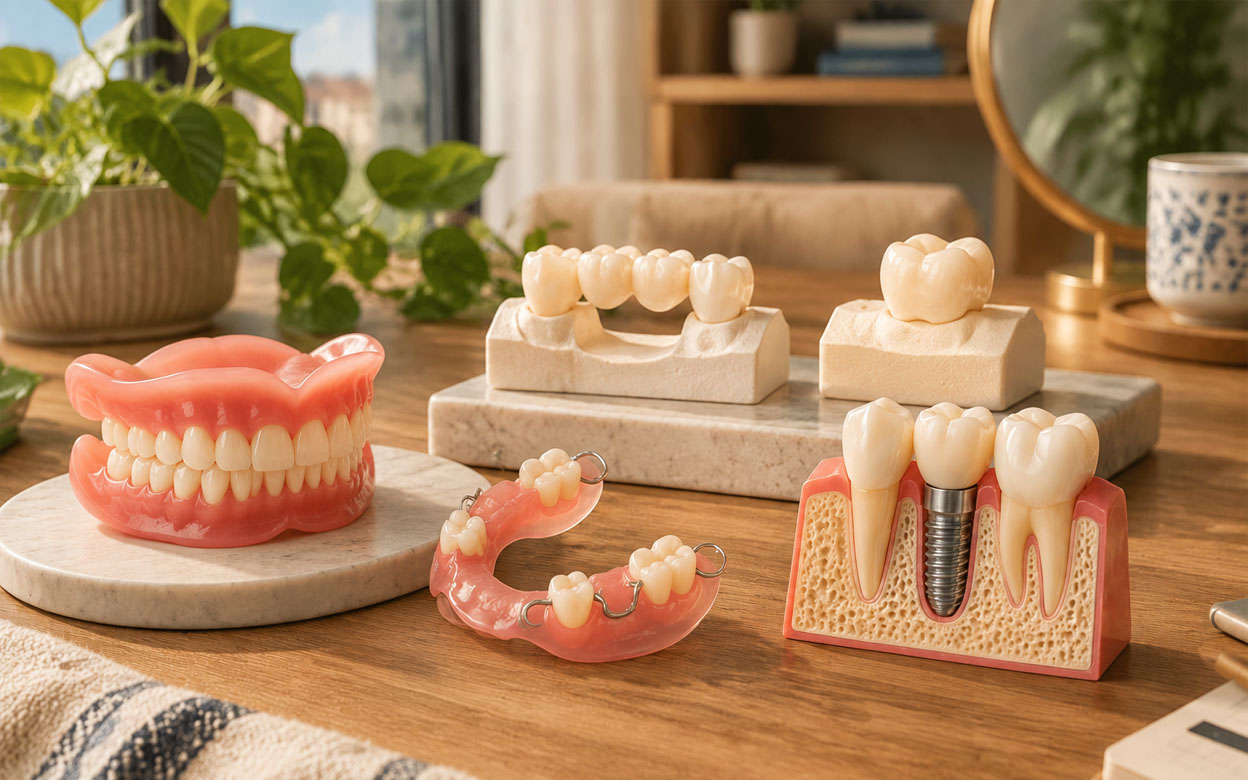
A dental prosthesis refers to artificial dental restorations designed to replace missing teeth or restore damaged teeth.
Dental prostheses include treatments such as crowns, dental bridges, dentures, and implant-supported restorations.
The goal of dental prosthetics is not only to fill missing spaces but also to restore chewing function, improve smile aesthetics, and maintain proper balance between the teeth.
Dental prostheses are generally divided into:
Fixed dental prostheses
Removable dental prostheses
Implant-supported dental prostheses
The best option should be selected after a complete dental examination.
A fixed dental prosthesis is a restoration that cannot normally be removed by the patient.
The most common types include:
A dental crown is a protective cover placed over a damaged or weakened tooth. It helps restore the tooth’s shape, strength, and appearance.
Crowns are often used for teeth that have significant damage, large fillings, or have undergone root canal treatment.
A dental bridge is used to replace one or more missing teeth.
In a traditional bridge, the artificial tooth fills the empty space and is supported by neighboring teeth.
Dental bridges can improve chewing ability and restore the appearance of the smile.
A removable dental prosthesis is a restoration that the patient can remove from the mouth for cleaning and maintenance.
The two main types include:
A partial denture is used when a patient has lost some teeth but still has natural teeth remaining.
It replaces missing teeth and helps restore chewing function and appearance.
A complete denture or full denture is used when all teeth in one jaw or both jaws are missing.
It replaces the entire set of teeth and helps improve speech, chewing, and facial appearance.
Dental implants can be used as a foundation for crowns, bridges, or complete dentures.
In an implant-supported dental prosthesis, implants are placed inside the jawbone, and the dental restoration is attached to them.
Depending on the treatment plan, implant-supported prostheses can be either fixed or removable.
One of the main advantages of implant-supported dentures is improved stability during chewing and speaking.
One of the most common questions is:
“Is a fixed dental prosthesis better than a removable one?”
A fixed prosthesis cannot be removed by the patient and often provides a feeling closer to natural teeth.
A removable prosthesis can be taken out for cleaning and may be a suitable option for people who have lost multiple teeth.
However, there is no single best option for everyone. Factors such as:
Number of missing teeth
Condition of remaining teeth
Gum health
Jawbone structure
Possibility of using dental implants
all play an important role in choosing the right treatment.
Dental prostheses may be recommended for people who:
Have lost one or more teeth
Have multiple missing teeth
Have severely damaged teeth that require restoration
Want to improve chewing ability and smile appearance
Need a bridge or implant-supported restoration
The appropriate type of dental prosthesis should be determined after evaluating the teeth, gums, and jawbone.
Dental implants and fixed prostheses are not always separate treatments.
In many cases, implants can be used as a foundation for fixed dental restorations.
For example, a single implant can support a dental crown, while multiple implants can support a bridge or full-mouth restoration.
The most suitable treatment depends on the number of missing teeth, bone condition, and overall oral health.
The lifespan of a dental prosthesis depends on several factors, including:
Type of prosthesis
Material quality
Treatment design
Oral hygiene
Regular dental care
Removable dentures are not permanent and may require adjustments or replacement over time due to changes in the gums and jawbone.
Proper cleaning, good oral hygiene, and regular dental visits can help extend the lifespan of dental prostheses.
Dentures are one type of dental prosthesis. However, the term dental prosthesis is broader and includes crowns, bridges, removable dentures, and implant-supported restorations.
Fixed dental prostheses cannot be removed by the patient. If removal is necessary, it should be performed by a dentist.
Depending on the number and location of missing teeth, the condition of remaining teeth, and jawbone health, options may include bridges, partial dentures, or implant-supported restorations.
Dental prostheses are not limited to older adults. Tooth loss or severe tooth damage can occur at different ages, and treatment is chosen based on each individual’s condition.
A dental prosthesis is one of the main solutions for restoring or replacing damaged and missing teeth.
Dental prostheses can be fixed, removable, or implant-supported, and each type has specific applications.
Choosing the right option requires a careful evaluation of missing teeth, remaining teeth, gum health, jawbone condition, and the patient’s expectations.
If you have lost one or more teeth or need guidance choosing between fixed dental prostheses, removable dentures, dental bridges, or implant-supported restorations, you can visit Dr. Zahra Sadat Shamekhi’s dental office in the Mollasadra and Vanak area of Tehran for a professional consultation.
After evaluating your teeth, gums, and oral condition, the most suitable treatment options can be discussed and selected.